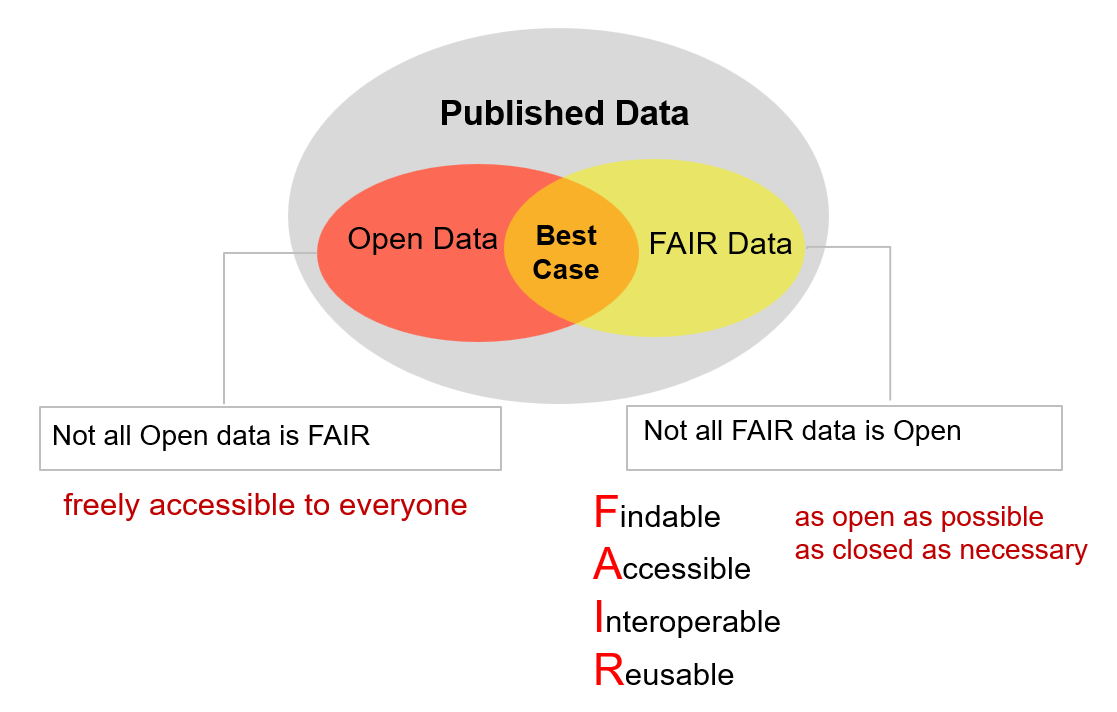
Open & FAIR Data
1. Open Data & FAIR Principles
When is data considered “open”?
Imagine you find exactly the data you are looking for. Can you simply download it and use it for your purpose?
If so, it is Open Data: data that is freely accessible and can be reused.
However, just because data is openly available and accesible does not necessarily mean that it is easy to find or well documented. This is where the FAIR principles come into play.
Open Data and FAIR Data: What is the difference?
FAIR stands for:
- Findable
- Accessible
- Interoperable
- Reusable
Importantly, FAIR does not automatically mean open. FAIR data follows the principle “as open as possible, as closed as necessary”. This means that data should be made openly available unless legal, ethical, or data protection requirements prevent it.
Example: As open as possible, as closed as necessary
Research data containing sensitive personal information may be findable and well documented through detailed metadata. However, access to the data itself may be restricted for data protection reasons. Such data can be FAIR without being Open Data.
Key Takeaway:
- Not all Open Data is FAIR. For example, sufficient documentation may be missing.
- Not all FAIR Data is Open. For example, access to the data may be restricted.
Best-case scenario: Data is both open and FAIR.