
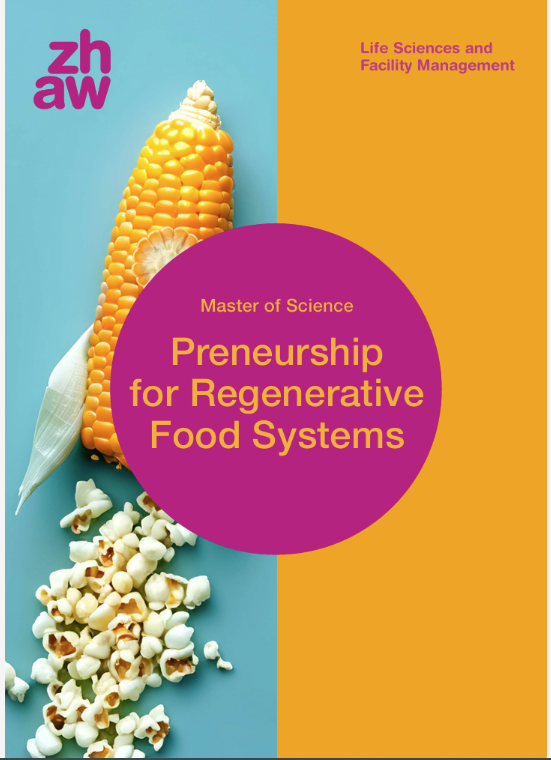
Master's degree Preneurship for Regenerative Food Systems
Master of Science – Life Sciences and Facility Management
Food is at the heart of human and planetary wellbeing – but current food systems are under pressure. Climate change, biodiversity loss, unhealthy diets, and fragile supply chains are pushing us to rethink how food is grown, distributed, and valued. The future depends on solutions that regenerate ecosystems, strengthen communities, and spark new ways of doing business.
Are you driven to create food systems that give back more than they take? Do you see opportunities where others see problems? Then this Master's programme is for you.
Let's shape the future of Life Sciences together.
![[Foto: zwei Studierende im Praxisumfeld einer Küche]](https://moodle.zhaw.ch/pluginfile.php/2725228/course/summary/blobid0.png)
Abbildung 1: Studierende im praktischen Lernumfeld
Content and Objective
To secure our future, food systems need to be regenerative and resilient—and in this Master's programme, you'll learn how to create them. The programme offers a dynamic blend of sustainability, entrepreneurship, business and science. It invites visionaries and changemakers to design food futures that are healthy for people, fair for farmers, and restorative for the planet. You'll explore food systems, technologies, regenerative strategies, and innovative ways to turn your ideas into real solutions.
Structure
Your studies cover core modules, elective modules, individual skills modules, project work, and a Master's thesis, totaling 90 ECTS credits. At the heart of the curriculum lies the «Agro Food Project», which runs over four semesters. You'll work on a real-world challenge from industry, research, NGO, or your own idea, developing a regenerative business model. The curriculum spans a broad range of topics: from food systems, sustainability, ecosystems, regenerative strategies, business modelling, finance, and innovation, to food tech, social science, and psychology.
Key Competences
The programme enables you to combine big vision and practical action. You will have all abilities needed to drive systemic change and to develop food systems that regenerate ecosystems, communities, and economies. This includes fundamental understanding of ecology and regeneration, expertise in technology and regenerative design, entrepreneurial thinking, leadership and business management skills, as well as communication and presentation skills.
Career Perspectives
As a graduate, you can either found and run your own sustainable food projects and start-ups, or work in the food industry or the public sector, in NGOs or think tanks. You are also equipped to work in international organisations implementing global projects on food security, resilience, and regeneration, e.g. GIZ and WHO. Typical job titles include: Consultant, Business Innovation Manager, Project Manager or Founder.
Individual Study Journey
During your first semester, you'll meet with your supervisor to agree on an Individual Study Journey (ISJ). This agreement outlines your personal objectives, electives, and individual skills modules. It allows you to design a study programme tailored to your interests, educational background, and career aspirations.
Good Reasons
- Meaningful: Develop solutions that actively transform food systems—for a sustainable future.
- Entrepreneurial: Engage in a programme that blends rigorous analysis with hands-on social entre- and intrapreneurial action.
- Personal: The highly flexible curriculum is tailored to your individual goals, supported by dedicated professional coaches.
- Transformative: Collaborate in small, dynamic teams to create regenerative business models that make a difference.
- Community: Join a thriving community connected to a vibrant ecosystem of start-ups, companies, organisations, and alumni.
Did you know?
Info: Thirty-five student-led projects have made a real-world impact since 2022. Two-thirds continue their project after graduation.
Twenty nationalities – the PREFS student network brings together talents from around the world, united by a love of food that nourishes, connects, and inspires.
Six out of nine planetary boundaries are already exceeded. Regenerative systems restore resources and create a net-positive impact.
At a glance
| Kategorie | Details |
|---|---|
| Title | Master of Science (MSc) ZHAW in Preneurship for Regenerative Food Systems |
| Topics and Tracks | Highly personalised studies thanks to elective modules, individual skills modules, and Agro Food Project. |
| Cooperation | Students benefit from networking with institutions like agricultura regeneratio, dieCuisine, Food Campus Berlin, foodward, Juckerfarm, Patiswiss, Smiling Gecko, Soil to Soul, SVIAL, Swiss Food & Nutrition Valley, Swiss Food Research, and the ZHAW Entrepreurship initiative. |
| Learning Concept | Research-based learning with strong emphasis on real world projects, combining independent study, contact lessons, and e-learning. A wide range of elective modules and a flexible structure allow for tailoring the programme specifically to your interests. |
| Duration | Regular study model: 4 semesters (part-time) | Extended study model: 6–8 semesters (part-time)—please contact us for individual counselling. |
| Workload | 90 credits (ECTS). 1 credit equals 25-30 hours of work. |
| Key Dates | Application deadline: October 31 for all applicants | September 30 for applicants requiring a visa. Studies start in February (week 08). |
| Location | Wädenswil ZH and other locations as well as online |
| International Mobility | More on international mobility here: www.zhaw.ch/en/lsfm/studies/international |
| Language | English (expected level: C1) |
| We study paperless | All learning materials are made available electronically. |
| Tuition Fees | CHF 720 per semester. Additional CHF 500 for students living outside Switzerland. |
| Entry Requirements | Bachelor's degree in business, nutrition, environmental science, agricultural science, food science, hospitality management, or a related discipline. Admission from diverse fields is standard. Candidates may be admitted sur dossier, based on professional experience and prior education. |
| Info Events | www.zhaw.ch/lsfm/infoevents |
Maya Ladner
Programme Director Preneurship for Regenerative Food Systems
msc-prefs@zhaw.ch
What exactly is «Preneurship»?
Definition: Preneurship describes the ability and practice of developing and implementing new ideas, products, or business models—whether as a founder, innovator within existing organizations, or in the nonprofit sector. It combines creativity, entrepreneurial thinking, and implementing innovations.
ZHAW Zurich University of Applied Sciences
School of Life Sciences and Facility Management
Registrar's Office
Gruentalstrasse 14
P.O. Box
8820 Wädenswil | Switzerland
Tel. +41 58 934 59 61
msc-prefs@zhaw.ch
For further Information: www.zhaw.ch/lsfm/master/en
September 2025