Legal aspects
Checking the terms of use
The publication of data does not automatically grant permission for their reuse. Before reusing data, you should therefore check whether and under what conditions the data may be used, modified or shared.
For published datasets, information about the terms of use can often be found:
- in the licence terms,
- in the terms and conditions of the websites of data providers.
For unpublished data, permission from the data author is required before the data can be reused. If the data contain personal information, you should also check whether the informed consent given by the participants allows the data to be reused for the intended purpose.
What are the terms of use based on?
The terms of use are often based on legal requirements. Copyright and data protection laws are particularly relevant in this context.
Intellectual property, copyright & licenses
▾
According to Art. 2 Abs. 1 URG, a work is protected by copyright if the following conditions are met:
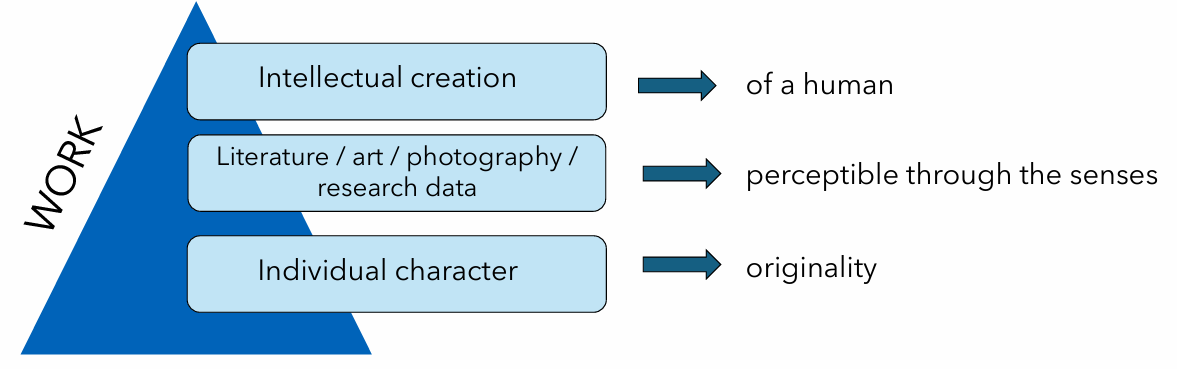
Not protected by copyright are, for example:
- Ideas, as they cannot be perceived by the senses.
- Telephone directories or legal texts, as they lack individual character and the required originality.
- Generally, AI-generated content, as it is not the intellectual creation of a human being. Please note: Exceptions may apply depending on how the content was created and the extent of human involvement.
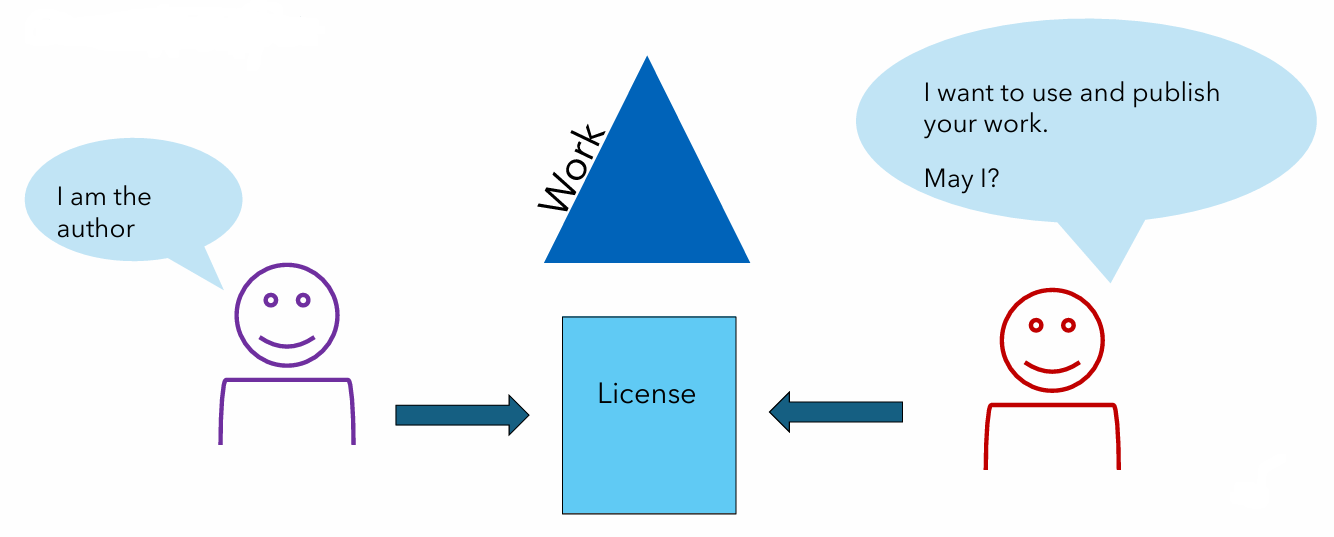
In practice, obtaining permission from the copyright holder for every intended reuse would be very time-consuming. To simplify this process, copyright holders can apply licences that clearly define whether and under what conditions their works may be reused.
Common licence types for research data
For research data, Creative Commons licences are widely used. In cases where research data are published together with software or source code, permissive and copyleft licences are also frequently encountered.
- Creative Commons (CC) licences are widely used for research data. They facilitate data sharing and reuse by clearly defining the conditions under which a dataset may be used. Depending on the licence, these conditions may include attribution of the original creator (CC BY) or sharing derivative works under the same licence (CC BY-SA). The most open licence, CC0, allows data to be reused with almost no restrictions.
- Would you like to learn more about Creative Commons licences? Here you can find the detailed information on CC licences.
- Permissive licences are mainly used for software and source code. They allow extensive reuse: the code can generally be used, modified and shared. Only a few conditions apply, such as acknowledging the original authors or retaining licence and copyright notices. A key feature is that modified or further developed versions do not necessarily have to be published under the same licence. This makes permissive licences particularly flexible for reuse.
- Examples: MIT License, Apache License 2.0, BSD-Licenses
- Copyleft licences are primarily used for software and source code. They generally allow users to use, modify, and redistribute the code. However, unlike permissive licences, copyleft licences require that modified versions distributed to others be released under the same licence or a compatible one. This helps ensure that the rights and freedoms granted by the original licence are preserved in all subsequent versions and derivative works.
- Exampl: GNU General Public License (GPL)
Recommendation: For more information on copyright, including AI-related and licensing issues, see these FAQs.
Data protection law ▾
Data protection law protects individuals whose data are collected and processed (for example, as part of surveys).
Personal data are any information relating to an identified or identifiable person. If a person can be identified directly or indirectly, the information is considered personal data. Under legal regulations, personal data must be anonymised before reuse (Art. 22 FADP). Personal data must not leave local servers. Therefore, personal data may not be uploaded to or processed using cloud-based services, including AI tools.
Anonymisation involves removing identifying information so that the data can no longer be linked to a specific person, or only with disproportionate effort. Anonymised data are generally no longer considered personal data and therefore no longer fall under data protection law.
- Increased risk of re-identification through AI: AI tools can link large amounts of data from different sources. This may increase the risk of re-identifying individuals in anonymised datasets. Anonymisation should therefore be carried out as thoroughly as possible.
- Important: The informed consent must specify whether study participants have agreed to the reuse of their data beyond the original research purpose (e.g. in other research projects).